
Someone searches for “holiday home by the sea”. Clicks cost money, so I count what they brought in.
Ads on Google or on Facebook and Instagram: I set up the campaigns, run them, watch them and show you each month how many people they brought and what that cost. The account stays yours, you pay the budget to the platform, and I promise no result.
A customer searches
holiday home by the sea
What I see
What I can promise, and what I can't
Ads are easiest to sell with promises. So I start with what I don't promise.
What I don't promise
Orders, revenue or a position
The contract says so plainly: no particular result is guaranteed.
That a higher bid wins
Google decides where an ad shows from the bid and the ad's quality at the time of the auction. A better ad can often cost less per click.
That an ad shows at once
Google reviews most ads within one business day, Meta within 24 hours, sometimes longer. Both may review an ad again while it runs.
What I do
I set them up and launch them
Up to two campaigns on one platform.
Tags on every link
So it is clear which ad brought a visitor.
I watch and adjust
What doesn't work, I change or stop.
I show you each month
What was spent, how many came and what each cost.
How the money works
There are two sums, and they go to different payees.
My work
A fixed price a month, paid to me in advance. It doesn't depend on how much you spend on ads.
The ad budget
You pay it to the platform directly, in your account. You set the budget.
- Paying per click, you pay only when the ad is clicked. You set the most you will pay, and you are often charged less.
- For most campaigns a day may spend up to twice the average daily budget, but a month no more than 30.4 times it. The budget can be changed at any time.
Meta (Facebook and Instagram)
- One day may spend up to 75% more than the daily budget, but a week no more than seven days' budget.
- Meta requires a minimum budget. It depends on the country and the campaign's objective, so I tell you once the country and objective are set.
Google or Meta
One service, one platform. Which one depends on whether people are already looking for you.
The ad shows to someone already searching: “holiday home by the sea”, “plumber in Kaunas”. It suits people who know what they want.
Worth knowing
Location
Google can show ads around a place, with a radius of at least 1 km. A radius too small may mean the ad shows now and then, or not at all.
Where Meta ads show
Depending on the objective and the ad: Facebook, Messenger, Instagram, WhatsApp, Threads and Meta's partner apps. We choose the places together; adding more doesn't make the ad cost more.
If you let a property
Meta treats housing ads (sale, rental and temporary housing listings) as a special category when the audience is in Lithuania. Choosing the audience by age, gender or postal code is limited or unavailable, and an undeclared ad may be rejected. Hotels and resorts are outside it. Meta doesn't say whether a holiday home is in it, so we check before starting.
The account stays yours
I don't need your password. You give me access, and you take it away.
You invite me to your Google Ads account and choose the access level. You can remove it at any time.
Meta
In your business portfolio you add me as a partner and choose which assets to share and at what level. We both see what is shared.
If we stop working together, the account, the campaigns and their history stay with you.
How I count what an ad brought in
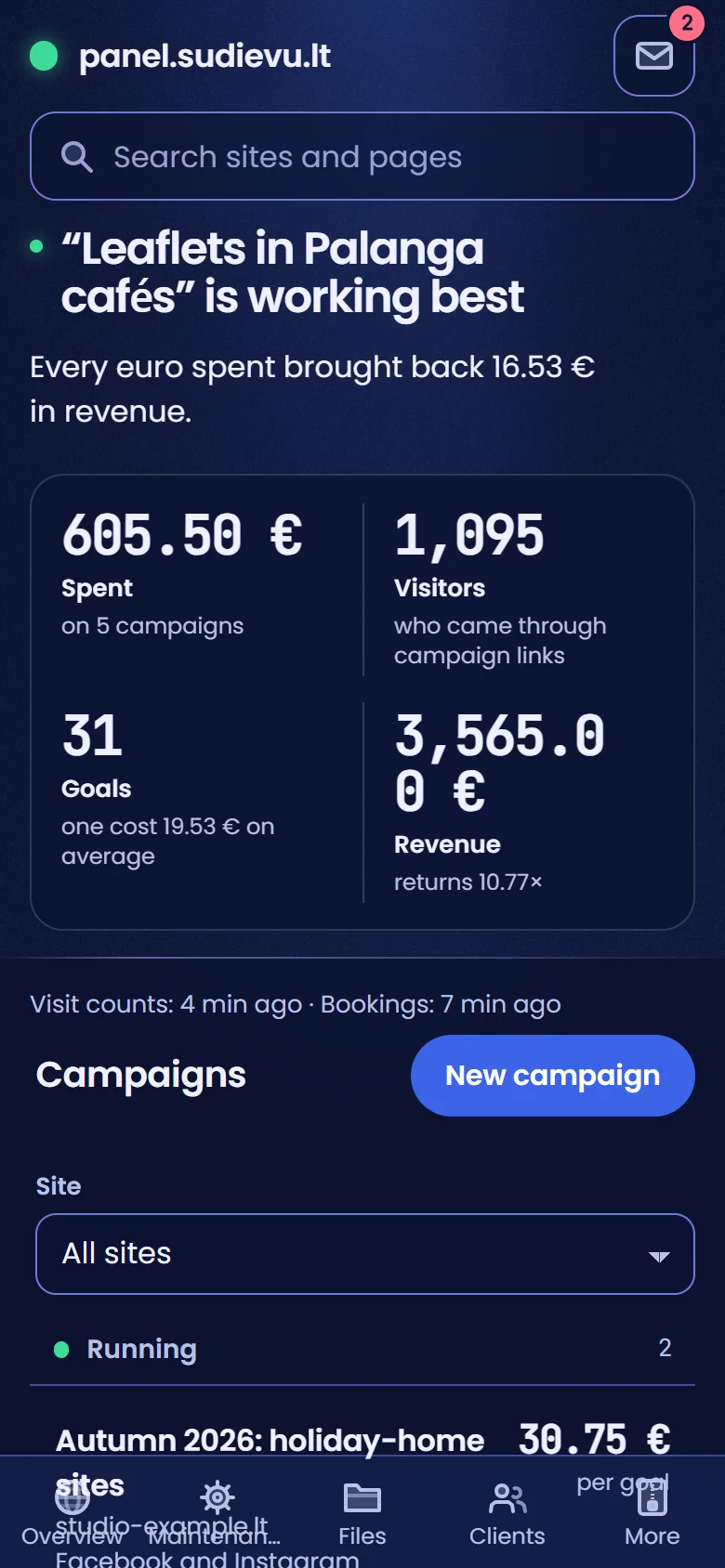
The platforms show clicks. What matters more to me is what happened on your site.
How it works
A tagged link
Every ad leads to your site through a link with three tags: where it came from, by which channel, and which campaign. Meta itself says results like these need a website analytics tool.
A counter with no cookies
The site's counter picks up the tags and counts: how many came, how many stayed, and how many reached a goal, such as sending an enquiry. Where the site's bookings are connected to the panel, the goal is a paid booking. A visitor counts for a campaign only on the day they came through its link.
The spend
I enter what was spent from the platform's report. The control panel works out what one visitor and one goal cost, and, where bookings are connected, what came back for each euro spent.
Each month, to you
This page of the control panel is mine. I show you the results every month.
No pixel
The Meta Pixel is code on the site that measures what visitors do, and retargeting ads, shown to people who have already visited, are built on it. Google's conversion tag places a temporary cookie on the visitor's device after an ad click. My sites have neither, and no cookie banner either. So there is no retargeting, and the platforms get no data from the site on what visitors do.
I can count this way on sites that carry my counter. A site starts keeping the tags only once its privacy notice says so, and I write that line.
Anyone can see the ads
Both platforms show who is advertising and who pays for it.
Google's Ads Transparency Center shows the advertiser and who pays for the ad.
Meta
Anyone can browse Meta's Ad Library. It holds every ad running now, and in the EU the advertiser's and the payer's details too.
You pay from your own account, so your name shows there. And before we start, we can look at what others in your field are showing.
Price
One price for my work. The ad budget is separate, and goes to the platform.
Ad campaigns
€44.50 a month
One platform, up to 2 campaigns, set-up included.
- Paid each month in advance.
- You can stop at any time; unused days are refunded.
The price doesn't include the ad budget. You pay the ad budget to the platform directly.
No VAT is charged: I am not a VAT payer. All prices
How we work
From a message to the first monthly report.
You write
What you want to advertise, to whom, and how much you would like to spend a month. You will hear back within one working day.
You give me access
You create the account and the payment method yourself and invite me. I do not need your password.
I set up and launch
Up to two campaigns, every link tagged. The platform reviews each ad before it runs.
Each month I show you
How much was spent, how many people came and what each one cost. What does not work, I change or stop.
Common questions
Short answers, no promises.
How much does an ad campaign cost?
My work is a fixed sum a month (see Price, above). You set the ad budget and pay it to the platform directly.
Do you invoice? Is there VAT?
I invoice my work each month. There is no VAT, as I am not a VAT payer. You pay the ad budget to the platform directly, so it is not on my invoice.
Do you guarantee a result?
No. The contract says so plainly. I promise the work, and clear numbers each month.
How soon will the ads show?
Once a campaign is ready, the platform reviews it: Google most ads within one business day, Meta within 24 hours, sometimes longer. When orders will come, nobody can say.
Can I see how others advertise?
Yes, anyone can: in Google's Transparency Center and Meta's Ad Library.
Can you run both Google and Meta?
Yes. One service covers one platform, so both platforms are two services.
Why no pixel?
Because the Pixel collects data on what your visitors do for the platform, and Google's conversion tag places a cookie on their device. Without them there is no retargeting, but I still see from the tags what each campaign brought in.
Do I have to learn Google Ads or Meta?
No. You create the account and add the payment method, give me access, and I build and look after the campaigns.
Write to me
Tell me what you want to advertise, to whom, and roughly what you would spend a month.
You will hear back within one working day.