
Search and SEO
Someone searches “plumber in Kaunas”. Nobody can promise you first place.
Do they find you? A good place in search can be earned, but not bought and not promised. The groundwork can be done right and kept up. That is what I do, and my control panel checks regularly that it is still there.
The customer searches
plumber in Kaunas
What I see
Promises
What I can promise, and what I cannot
I start with the limits, because promises are the easiest thing to sell here.
No one can guarantee a #1 ranking on Google.
What I do not promise
First place
So I promise no place and no timeframe.
That Google will include you
Google finds, reads and shows pages. It guarantees none of the three steps.
A better place for money
Local results rest on relevance, distance and prominence, and a better place cannot be bought. Under Google’s rules, buying links for ranking is spam.
Magic keywords
The keywords tag has no effect on search.
What I do
Set the groundwork up by hand, once
While the site is built.
Check it on a schedule
Nightly on my server, weekly elsewhere.
I see what Google sees
And tell you what matters.
Fix what the check finds
The panel fixes nothing itself. I do.
How it works
How search works
Three steps, and none of them is in your hands.
1Crawl
Find
Google’s program follows links and reads the sitemap to find pages.
2Index
Read
It works out what a page is about: its title, its text, its language and its structured data, and it reads the phone version.
3Serve
Show
When someone searches, it picks pages. It ranks content made to help people, not made to rank, and trust weighs most.
Google promises none of the three steps. All you can do is make each one easier for it.
What a reader wants
- An answer to what they searched for, not a page written for a robot.
- A page that loads fast and reads well on a phone.
- Someone they can trust.
What a search engine wants
- A page it can find: links and a sitemap.
- A page it can read: a title, clear text, a marked language.
- A page it can understand: a clear structure and, where it fits, structured data.
It is mostly the same work: a page that is clear to a person is clear to a search engine. So the long-term work is to write what your customers ask, and to write it clearly. I collect such texts on the blog
Groundwork
The groundwork, set up once
When I build a site I do this by hand. Here is everything it covers, and what each thing does not do.
On the site and around it
A title on every page
Every page has its own title. It shows in the search result as the link.
The description
The snippet under a result mostly comes from the page itself, sometimes from the description. I write it for a person. Google says nothing about its effect on ranking.
Headings
Every page has one main heading and a clear order below it.
A sitemap
It helps Google find your pages. It does not put any of them into search.
robots.txt
It tells robots where not to go. It does not keep a page out of Google: the noindex tag does.
The main address
I say which address is the real one (canonical). It is a strong signal, not an order.
Language versions
The Lithuanian and English versions are linked (hreflang), so a reader gets their own language.
Structured data
It helps a search engine understand the page and sometimes makes an enhanced result possible. It guarantees nothing.
Search Console
Free. You do not need it to be in search. You need it to see what Google sees.
Google Business Profile
Free, where the business is eligible. I set it up only where it fits. It does not buy a better place.
Speed and the phone
Speed
Google’s targets: the largest element loads within 2.5 s, a tap is answered in under 200 ms, and the page does not jump about (CLS under 0.1). Whether the page answers the question still comes first, and Google does not publish how much speed weighs.
The phone layout
Google indexes the phone version of a site, so I set it up and test it while the site is built.
All of it is free with a site I build or host. Prices are in section 07.
AI search
AI search
There is a lot of noise here. I separate what the providers publish from what nobody knows yet.
What is established
Google’s AI answers need nothing extra
To appear in Google’s AI Overviews and AI Mode a page only needs to be indexed and eligible to show a snippet. No special writing is needed.
Search crawlers
OpenAI’s OAI-SearchBot, Anthropic’s Claude-SearchBot and PerplexityBot are search crawlers, and robots.txt controls them.
Training crawlers
GPTBot, ClaudeBot and Google-Extended are about training models. Blocking them does not take you out of search, and Google-Extended does not affect Google Search.
What is still uncertain
llms.txt
It is a 2024 proposal. Google Search says it does not use it, and OpenAI, Anthropic and Perplexity do not document reading it.
JavaScript
One vendor’s study (2024) found that the main AI crawlers did not run JavaScript. The safe bet is that your text is in what the server sends. It is one study, and an old one.
The control panel checks whether AI search bots are let in and answered, and reads llms.txt if there is one.
The routine
How I made it one routine
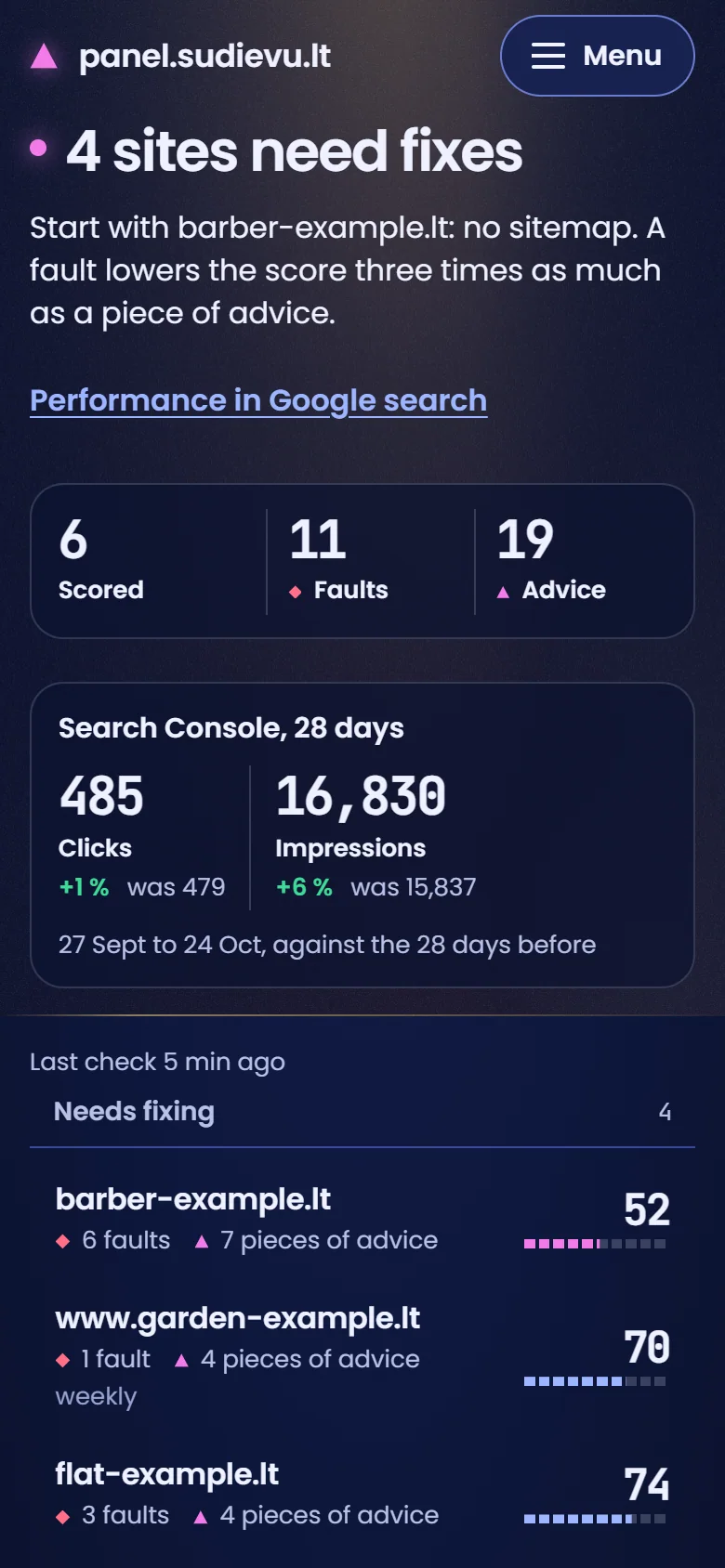
One person cannot watch all of this by eye. So my control panel does.
The nightly check
Sites on my server my control panel reads every night, and sites hosted elsewhere once a week.
- 32checks
- up to40pages for each site
- 100point scale
What it checks
- Status and redirects
- Title and description: present, and how long
- One main heading
- Language
- Canonical address
- Language versions
- Sharing tags
- No stray noindex
- Broken internal links
- Page weight
- Server response time
- robots.txt
- Sitemap
- http to https
- Structured data that parses
The result is a score out of 100 and a to-do list, faults first. Beside it I see the site’s own Search Console numbers: clicks, impressions and queries. It also checks whether AI search bots are let in.
The panel reads and scores, but fixes nothing itself: I fix. It does not measure the speed targets or the phone layout every night: those I set up and test when the site is built.
Social profiles and directories
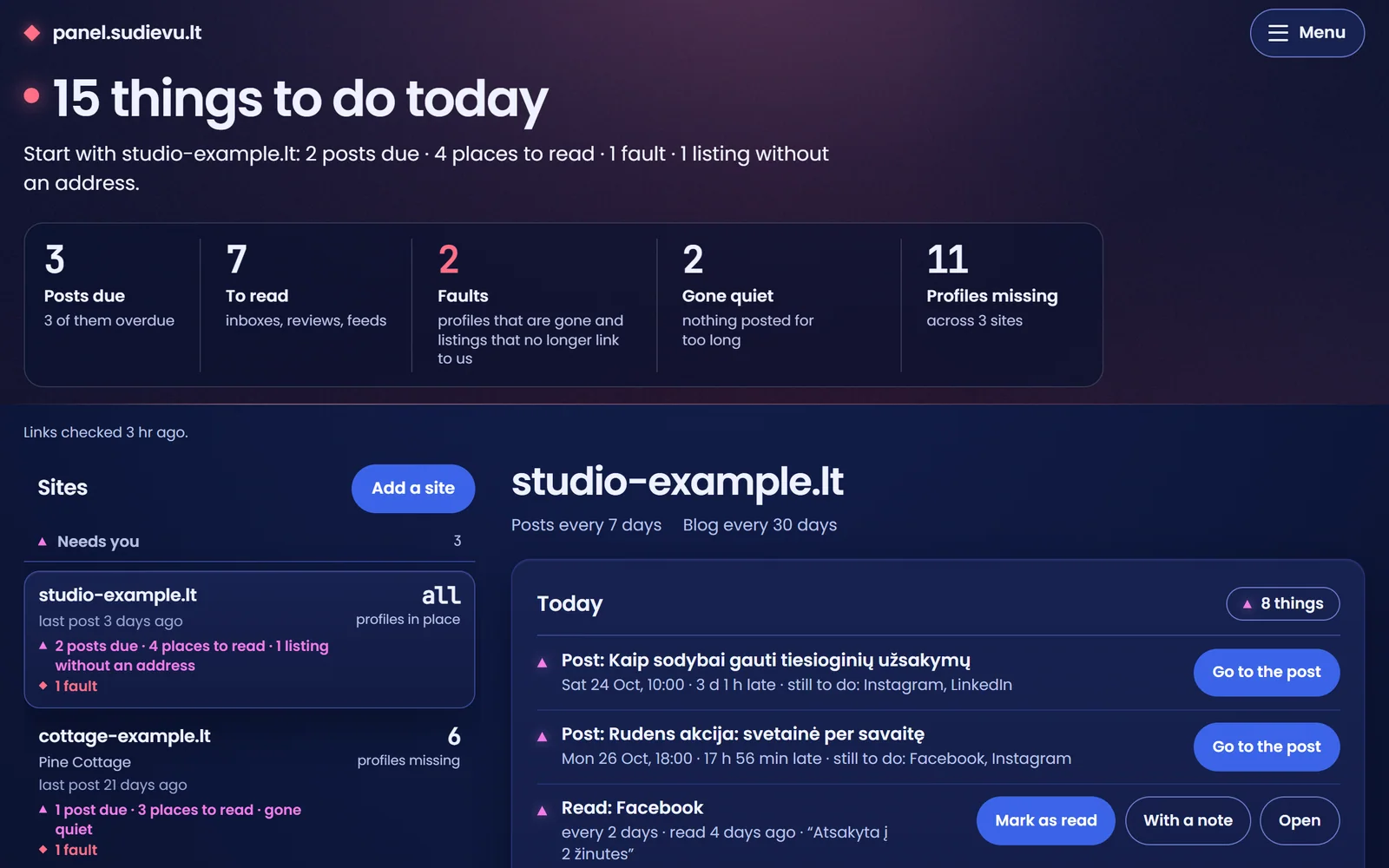
Nearly the same job beyond the site. My control panel has one Social page, with a row for each site.
- The social profiles.
- Directory listings: each day the panel checks whether they still exist and still link to the site.
- The site’s latest blog posts.
- A plan and a log of posts, kept by hand with due dates; the panel warns when a site has gone quiet.
- The inboxes and reviews due to be answered.
It posts nothing by itself: it is a plan and a log.
You or me
Do it yourself, or have me do it
You can do this yourself. It works. The difference is not in knowing, but in not having to think about it.
The groundwork
I do itSet up by hand while the site is built, free with a site I build or host.
You do itGoogle publishes a starter guide and Search Console is free. All of it can be done by yourself.
Looking
I do itMy control panel reads the site every night (weekly if it is hosted elsewhere) and makes the to-do list.
You do itYou open Search Console and look. The hard part is remembering to.
Fixing
I do itI fix what the check finds.
You do itYou fix what you noticed, or what you have time for.
Staying consistent
I do itThe same check on the same night, whether my week was calm or not.
You do itIt works as long as someone has the time. A site changes, and a change can break something unnoticed.
Cost
I do itSee section 07.
You do it0 €, and your time.
If you have the time and want to learn, do it yourself. What you buy from me is not a result, which nobody can promise, but not having to think about search.
Prices
Prices
The groundwork is free with a site I build or host, and the upkeep is free for my first clients.
Groundwork
€0 free with a site I build or host
Everything in section 03, set up by hand and tested.
Upkeep
€0 for my first clients
The nightly check, the to-do list and the fixing.
Social profiles
€44.50 a month
Running your Facebook and Instagram: 8 posts a month from your photographs, and I answer comments and messages once a week.
Prices exclude VAT: I am not a VAT payer. All prices
Process
How we work
From a first message to a standing check.
We get in touch
Write or call. I work out what you need and quote the options for your current site or a new one.
Audit and questionnaire
With your permission I audit your current site, downloading its files and keeping them only as long as the work needs them. I send a questionnaire with design, structure and layout ideas; you read the audit and answer.
You follow it in the client area
In the client area on sudievu.lt you log in, leave notes and watch the site being built.
We go live
The site goes public. I set up SEO free of charge. Where needed, I help set up Google Analytics, Ads, Tag Manager and Search Console.
Questions
Common questions
Short answers, without promises.
Do you promise first place on Google?
No. Nobody can, and Google says so itself. I promise what I can do: the groundwork and a standing check.
How long until I see a result?
Google gives no timeframe and does not even guarantee a page will be indexed, so I do not promise one either.
Do I need Search Console to be in search?
No, pages get into search without it. It is free and it lets you see what Google sees. I set it up with the site.
Can you do this for a site you did not build?
My control panel also checks sites hosted elsewhere, only more slowly: once a week. If you move the site to my hosting, the groundwork is free. Otherwise I name the price once I have seen the site.
Is it worth buying links?
No. Links are a search signal, but under Google’s rules buying them for ranking is spam.
Do I need to write specially for AI search?
No. Google says no special writing is needed, and robots.txt controls the other search crawlers. The panel checks whether they are let in.
Does the control panel fix faults itself?
No. It reads, scores and lists what to do. I fix.
Why are there no examples with numbers here?
Because nobody can promise a place, and a number without a source would be made up. I write only what the search engines publish and what my control panel does.
Start with the address
Tell me which site is yours and what people should search for to find you.
You will hear back within one working day.